
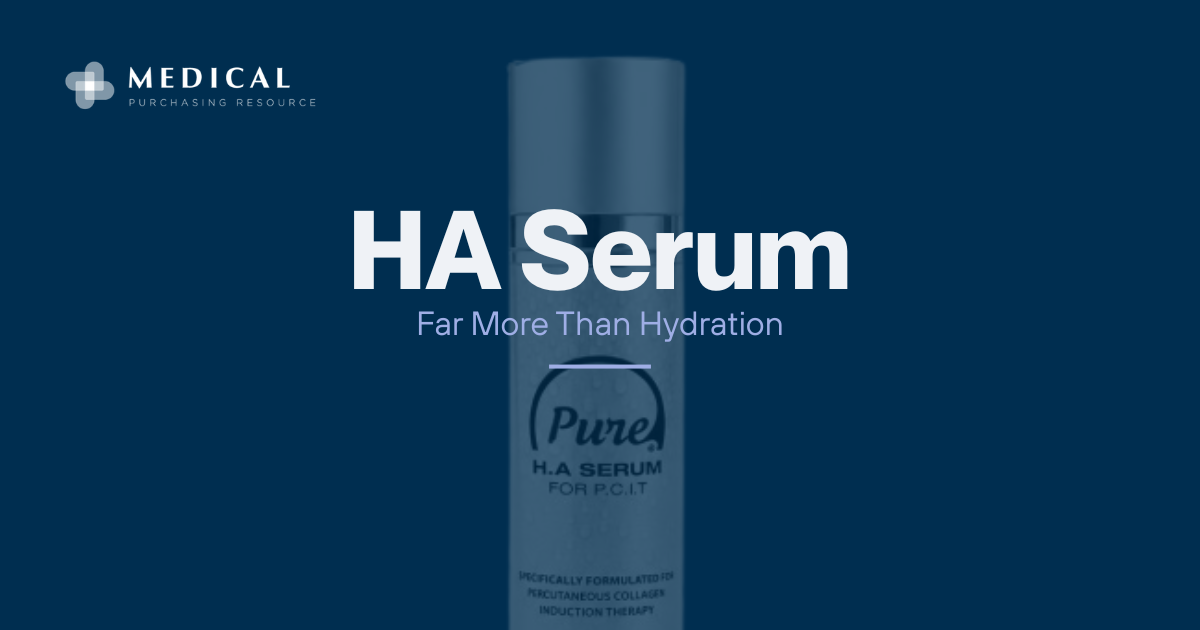
HYALURONIC ACID: Far More Than Hydration
Let’s look at one of the most commonly used ingredients in aesthetics:
Hyaluronic Acid (HA).
Most providers know HA for hydration, but attracting and retaining water is only part of its story.
WHAT IS HYALURONIC ACID?
HA is a naturally occurring molecule found throughout the body, including the:
- Skin
- Eyes
- Joints
- Connective tissue
In the skin, HA is an important component of the extracellular matrix (ECM). The ECM is the environment surrounding our cells. It provides structural and biochemical support that helps tissues function, communicate, adapt, and repair.
HA helps support:
- Hydration
- Tissue flexibility
- Cellular movement
- Wound healing
- Fibroblast migration and communication
- Regulation of inflammatory signaling
- Overall skin resilience
A SIMPLE WAY TO THINK ABOUT HA
Imagine the skin as a construction site.
The cells are the workers.
Growth factors and chemical messengers are the instructions.
The extracellular matrix is the work environment.
HA helps create the hydrated environment that supports cellular movement, communication, and tissue repair when healing is needed.
When skin becomes dehydrated, damaged, or chronically inflamed, these processes may become less efficient.
WHY HA IS IMPORTANT IN AESTHETICS
HA is used in many aesthetic products because it can help support:
- Skin hydration
- Treatment comfort
- Product glide
- Tissue flexibility
- A healthy healing environment
However, not every HA product functions the same way.
NOT ALL HA IS THE SAME
HA products can differ significantly based on:
- Molecular weight
- Concentration
- Viscosity
- Cross-linking
- Preservatives
- Sterility
- Packaging
- Intended use
Because of these differences, a topical HA serum, injectable skin booster, and dermal filler should never be viewed as interchangeable products.
MOLECULAR WEIGHT MATTERS
One of the most important differences between HA products is molecular weight.
Generally:
- Higher molecular weight HA tends to remain closer to the skin surface and supports hydration and barrier comfort.
- Lower molecular weight HA may penetrate more readily into the upper layers of the skin and can interact differently with the skin environment.
Higher molecular weight does not automatically mean better.
Lower molecular weight does not automatically mean better.
Molecular weight simply influences how that particular HA behaves.
CROSS-LINKED VS. NON-CROSS-LINKED HA
Non-Cross-Linked HA
Non-cross-linked HA remains in a more natural, fluid state and is generally broken down more quickly by the body.
It may be found in:
- Topical serums
- Procedure-support products
- Hydration treatments
- Some injectable skin boosters
Cross-Linked HA
Cross-linked HA has been chemically modified by connecting HA chains together.
This creates a stronger gel structure that is more resistant to breakdown and can provide longer-lasting volume or structural support.
It is commonly used in:
- Dermal fillers
- Volumizing products
- Structural support treatments
Cross-linked does not mean better.
Non-cross-linked does not mean inferior.
They simply perform different jobs and are intended for different clinical purposes.
WHY PACKAGING MATTERS
When evaluating an HA product, providers should look beyond the ingredient list.
Packaging can affect:
- Product protection
- Contamination risk
- Storage requirements
- Dispensing practices
- Intended use
HA products may be packaged in:
- Dropper bottles
- Vials
- Ampoules
- Syringes
- Roller applicators
- Pumps
- Airless pumps
Dropper Bottles
Dropper bottles are frequently used in retail and professional skincare products.
Because they are opened repeatedly, the dropper may accidentally contact the skin, gloves, treatment tray, or other surfaces.
This may be appropriate for intact skin when used according to manufacturer instructions, but it may not be ideal around freshly treated or compromised skin.
Vials and Ampoules
Vials and ampoules may improve portion control and reduce repeated exposure.
However, packaging alone does not confirm sterility.
Always verify:
- Is the product sterile?
- Is it single-use or multiuse?
- Does it contain preservatives?
- Can it be stored after opening?
- What is it intended to be used for?
Syringes
A syringe-shaped package does not automatically mean a product is injectable.
Some topical products are packaged in syringes simply for controlled dispensing.
Never inject a product unless it is specifically manufactured, labeled, and intended for injection.
Rollers
Roller applicators repeatedly touch the skin and return to the product reservoir.
This may increase contamination concerns, especially when treating freshly exfoliated, compromised, or post-procedure skin.
Pumps and Airless Pumps
Pump systems reduce direct contact with the product.
Airless pumps help reduce exposure to air and environmental contaminants.
However:
Clean does not mean sterile.
Airless does not mean sterile.
Sterility must always be verified separately from the packaging design.
WHY PURE HA SERUM P.C.I.T. MAKES SENSE
Now that we understand that not all HA products are the same, it becomes easier to see why choosing the right formula matters during professional treatments.
Pure HA Serum P.C.I.T. was designed specifically as a professional topical procedure-support serum. It is not intended to function as a dermal filler, injectable skin booster, or highly active corrective serum.
Its purpose is simple, but important:
To provide hydration, smooth surface glide, and treatment comfort when the skin needs supportive care during a procedure.
The formula contains:
- Hyaluronic Acid
- Water
- Phenoxyethanol
It is:
- Fragrance-free
- Peptide-free
- Non-injectable
- Designed for professional topical use
Because the formula is intentionally simple, providers know exactly what they are applying without unnecessarily introducing multiple additional cosmetic ingredients during a procedure.
Providers can expect:
- Smooth, consistent treatment glide
- Slower drying on the skin
- Improved surface hydration
- A cushioned treatment feel
- Easier movement across treatment areas
- Less need to repeatedly stop and reapply product
- Approximately 10–12 treatments per bottle, depending on usage
This makes Pure HA Serum P.C.I.T. a practical back-bar option for providers who want dependable performance without unnecessarily complicating their treatment protocol.
When the goal is hydration, cushion, comfort, and glide, a simple professional formula often makes more sense than a formula loaded with unnecessary ingredients.
Pure HA Serum P.C.I.T. is not a dermal filler.
It is not a cross-linked injectable HA product.
It is a professional topical serum designed to provide hydration, cushion, and smooth product movement during appropriate aesthetic procedures.
SAFE DISPENSING PRACTICES
Because Pure HA Serum P.C.I.T. is a multiuse back-bar product:
Do not allow the bottle opening or pump to touch the client, gloves, treatment tray, or device
- Dispense only the amount needed for the treatment
- Use a clean secondary treatment container when appropriate
- Never return unused product to the original container
HOW TO EVALUATE ANY HA PRODUCT
Before choosing an HA product, ask:
- Is it cross-linked or non-cross-linked?
- What molecular weight is being used?
- Is it topical or injectable?
- Is it sterile?
- Is it single-use or multiuse?
- What additional ingredients are present?
- How is it packaged?
- Is the viscosity appropriate for the intended use?
- Does the manufacturer support that use?
THE BIGGEST LESSON
The term “hyaluronic acid” does not describe a single product category.
Topical HA, injectable HA, sterile HA, preserved HA, cross-linked HA, and non-cross-linked HA are all different.
Even two products that both contain hyaluronic acid may behave very differently depending on their molecular weight, concentration, formulation, sterility status, packaging, and intended use.
The best question is not:
“Does this contain hyaluronic acid?”
The better questions are:
- What type of HA is it?
- What molecular weight is it?
- How is it formulated?
- How is it packaged?
- What is it intended to do?
- Is it appropriate for the condition of the skin?
- Does the manufacturer support that use?
The best providers do not choose HA simply because it is hydrating.
They choose the right HA, in the right form, for the right purpose.
Once you understand those differences, it becomes clear that selecting an HA product is not about finding the most expensive option or the most complicated ingredient deck.
It is about choosing a product that is appropriate for the skin condition, the procedure, and the treatment goal.
That is why a simple, professional formula like Pure HA Serum P.C.I.T. can become such a valuable treatment-room staple.
The right HA, in the right form, for the right purpose will always make more sense than using HA simply because it is present.
That is how providers treat more intelligently.
